

World War II-era military speak was full of colorful slang terms. For instance, a can of milk was known as an “armored cow.” Prunes, often sent to prisoners as part of Red Cross parcels, were called “Army strawberries.” A cup of coffee? That was “battery acid.” And then there was “torpedo juice,” a term that might seem like slang, but was the actual name of a drink consumed by soldiers.
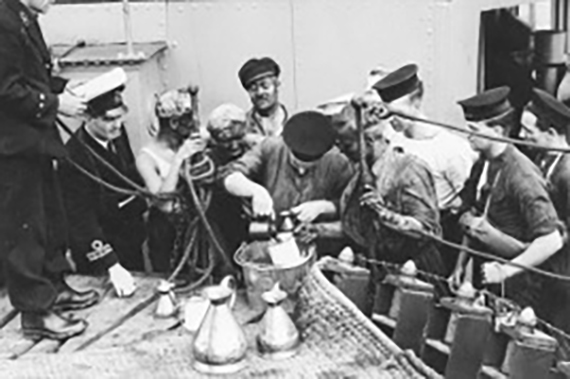
Torpedo juice, sometimes referred to by the lesser-known moniker Torpedo Tessie, was a highly alcoholic cocktail with a surprisingly literal name. Torpedoes of the era were fueled by 180-proof ethanol, a very potent variant of essentially the same neutral grain alcohol found in beer, wine, and spirits. Because liquor wasn’t otherwise accessible, soldiers would drain a bit of the fuel from a torpedo and mix it with fruit juice.
The resulting drink could be a dangerously strong highball. After all, 180-proof equates to 90% alcohol by volume. Most liquors that cocktails are commonly made from (i.e., vodka, whiskey) average between 40% and 45% alcohol by volume, so using the same amount of torpedo fuel would result in a drink that was at least twice as potent as one made with a conventional liquor. Pineapple juice was the most popular fruit juice for mixing the drink, though citrus juices (mainly orange, lemon, or grapefruit) were sometimes substituted. There wasn’t an exact recipe, but the mix ratio has been reported as somewhere between one part torpedo fuel to three parts fruit juice, or two parts torpedo fuel to three parts fruit juice — not very much dilution!
Eventually, the U.S. Navy caught on to the practice, and sought to prevent its rank and file from drinking weapons fuel. Torpedo fuel began to be formulated with an additive called Pink Lady, a blend of toxic methanol along with red dye to provide a visual warning. Later, the fuel was formulated with less harmful but still unpleasant Croton oil. Neither of these poisonous formulas did much to curtail the making of torpedo juice, as soldiers found ways to distill the fuel and remove the toxins.
During a 1964 Pearl Harbor reunion, a veteran (who wished to remain anonymous) described his process to the Omaha World-Tribune: “I had an in with the bake shop. We’d strain the juice from the torpedo through at least six loaves of bread to take out the oil and other impurities. Then I’d boil it and distill it through some copper tubing. We’d get a half cup to a gallon of juice that way.”