

WHO PICKS UP THE TAB?
Sometimes two thoughts come together and help make a little more sense of things.
“We’re in the amenities business.” So said Rich Firebaugh during a discussion among Board members near the conclusion of their September 21, 2026 meeting. He went on to say that it’s the Board’s responsibility to deliver a set of amenities desired by the members at a reasonable price.
Of course, Judge Smails (Ted Knight) would retort, “You’ll get nothing, and like it!” Just kidding.
Anyway, the other thought came from David “Drink” Drinkwater in an email to the Board Treasurer and others. Don’t ask me how he got the nickname. It’s beyond me.
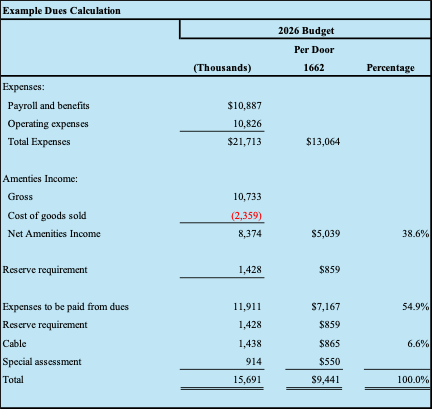
Drink suggested there might be a better way to help members understand the tradeoff the Board faces when setting the budget and deciding where the money is going to come from. Drink sent along a spreadsheet, which I have embellished here:
I suspect a few readers just zoned out. I mean, what can induce narcolepsy faster than an accountant with a spreadsheet?
Stay with me just a little longer. I think this one is worth understanding. At its most basic level, the budget process involves two important questions.
First: What amenities do we want, and what is a reasonable cost to provide them?
Second: Who should pay for that cost—the members who use the amenities, or the entire membership through dues?
Those questions are related, but they are not the same.
During the budget process, the Budget Committee, Finance Committee and Board have to make decisions about both. Once they establish a reasonable level of expense necessary to provide the amenities members expect, they then have to determine how that cost should be allocated. The table shows how the Board threaded that needle last year. If you include cable TV, which we all share in the cost of, about 61% of the expenses were shared among all members through dues. The remaining 39% were budgeted to be paid by individual members through meal prices, golf cart fees, lessons, and other user fees.
That 61/39 split is important because it illustrates something we sometimes overlook: not every amenity is funded in the same way.
Some amenities are used by nearly everyone and make up part of the overall cost of being a Heritage Palms member. Others are used primarily by those who choose to participate, and a greater portion of their cost can be recovered through user fees. There is no magic formula that determines exactly where that line should be drawn.
First, the Board must determine what amenities members want, and which ones they want emphasized. Fortunately, they have plenty of information to help make that determination, including usage statistics, survey feedback, and other member input.
They also have market data to consider—things like inflation, wages, insurance, and other costs that affect what it takes to operate our amenities. And, of course, they have to consider the competitive environment in which Heritage Palms operates. We aren’t the only club in SW FL offering golf, tennis, pickleball, dining, and other amenities.
Then there is the most subjective part of the equation: What is reasonable?
Each Board member is also a Heritage Palms member. They use the amenities, pay dues and user fees, and have a pretty good idea of what feels reasonable—just like the rest of us. They take all of that information, along with their experience and judgment, and try to arrive at the “reasonable price” Rich described.
Then comes the balancing act: How much of that price should be shared by the entire Heritage Palms community, and how much should be paid by the members who actually use a particular amenity?
And that’s where Drink’s spreadsheet becomes more than just a spreadsheet.
It gives us a way to see the budget from a different perspective. Instead of simply asking, “Why are our dues going up?” or “Why does this cost so much?” …. we can also ask, “Who is paying for it, and why?” Those are better questions.
At the end of the day, we are a member-owned community. We want great amenities. We want them maintained properly. We want new amenities when they make sense. And, most of us would prefer not to pay Ritz-Carlton prices for Holiday Inn Express amenities.
The challenge is finding the balance.
There probably isn’t a perfect formula—and I’m pretty sure there isn’t a spreadsheet big enough to make everyone happy. But if the goal is to provide the amenities members want at a reasonable price, while fairly balancing what is paid through dues with what is paid by the people who use them, then maybe we’re looking at the budget the right way.
After all, we’re in the amenities business.
And unlike Judge Smails, I think the goal should be to give members something they want—and make sure we can afford to keep giving it to them.