


Many assume that those who were managers during their working lives, would be good leaders in retirement. This may be a faulty assumption, largely because management is a push process – focused on plan, product, and performance while leadership is a pull process – focused on purpose, process, and participation.
A manager has formal organizational authority and thus, can act in accordance with performance policies and procedures. Subordinates must comply with directives (push) or experience consequences.
A leader, especially in a community of volunteers, has limited authority and must rely on his/her own skills to “pull” followers toward a given goal. The followers are volunteers and thus, serve at their own pleasure.
In a volunteer community, the leader should be facilitative or enabling, rather than authoritative. This style requires a set of skills that may differ from those of the traditional manager.
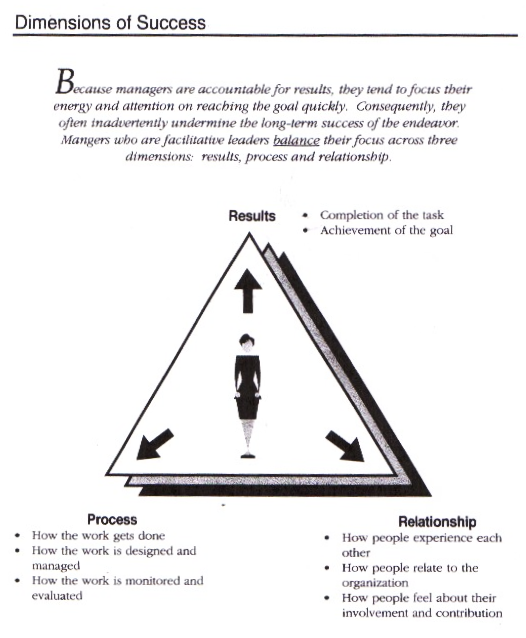
• Balance among results, process, and relationship. A good leader understands that while completion of the task is of utmost importance, it cannot be done without having a clear and understandable process as well as supportive relationships with others.
• Seek maximum appropriate involvement. Obtaining stakeholder input is essential for getting “buy-in” for new initiatives. The key word is “appropriate,” meaning that random sampling procedures should be used to obtain results which may be generalized to the population. Sampling allows a more economical and efficient way to obtain results.
• Design a Pathway to Action. At Toyota this skill is known as “grasping the situation.” Essentially it means addressing three critical questions: Where are we now? Where do we want to go (vision)? How will we get there (strategy)?
• Building Agreements. A community such as ours is comprised of diverse constituencies with varying positions on critical issues. The leader must find a way to gain “buy-in” from these constituencies before implementing a solution. “Buy-in” does not necessarily mean total agreement, but a solution that constituencies can “live with.” The traditional functions of a manager are planning, organizing, leading, and controlling. Many of these are used by the leader in a volunteer community; however, because a leader does not have the authority of an organization behind him/her, and because employees are not volunteers, a leader must rely on facilitative skills to accomplish goals.